The Tuesday problem
Most small businesses do not have an AI problem. They have a Tuesday problem: the owner is the only person who can quote, the only person who answers the awkward email, and the only person who remembers what was agreed in March.
Every inquiry, every job, every question runs through one head. You hired people to get your time back, and somehow every decision still lands on you:
“What do we charge for that?”
“What did we promise them?”
“Who’s handling it?”
They’re not asking because they’re incapable. They’re asking because the answer exists in exactly one place, and it’s your head.
This series is about taking specific pieces of that work out of your head and putting them somewhere that keeps running when you’re on a roof, in a van, or asleep — without handing a customer to a machine that makes things up.
Judge it before you pay for it
Chapter One of Book One, free and complete — 30 typeset pages including the Friday Audit. Run it on your own week and you’ll have a written cost estimate for your worst bottleneck, whether or not you ever buy anything. No email, no form.
What changes when you build this
Your week
- Quotes go out the same day, because quoting is lookup rather than a decision you have to be present for.
- Nothing sits in your inbox waiting for you to remember it — every inquiry has an owner and a next date.
- The routine questions get answered without you, from material you approved, with the awkward ones still reaching a person.
- You can be away for a week and the business keeps taking work.
Your business
- What was agreed is written down and findable in seconds, not reconstructed from three inboxes.
- Capacity stops being capped by how many hours you personally have.
- You know what each workflow actually costs and what it actually returns — in dollars, with the arithmetic shown.
- The system is documented well enough that someone else can run it and you can fix it.
Written for owners of businesses with one to thirty people — trades, professional practices, service firms. If you can build a spreadsheet formula, you can do everything in these books. No coding, and no software you have to buy.
AI Automation for Small Business
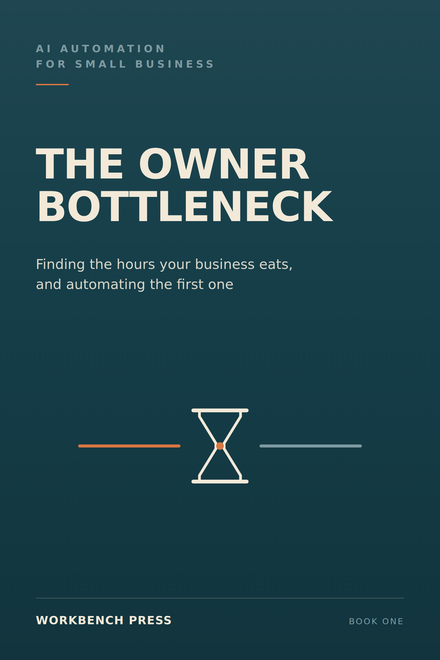 Book One
The Owner Bottleneck
Finding the hours your business eats, and automating the first one.
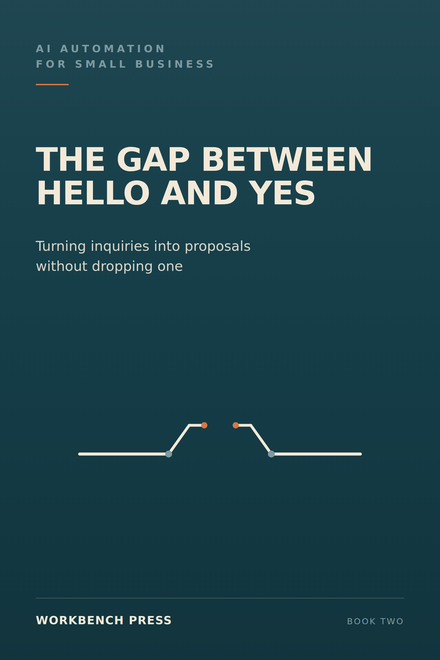 Book Two
The Gap Between Hello and Yes
Turning inquiries into proposals without dropping one.
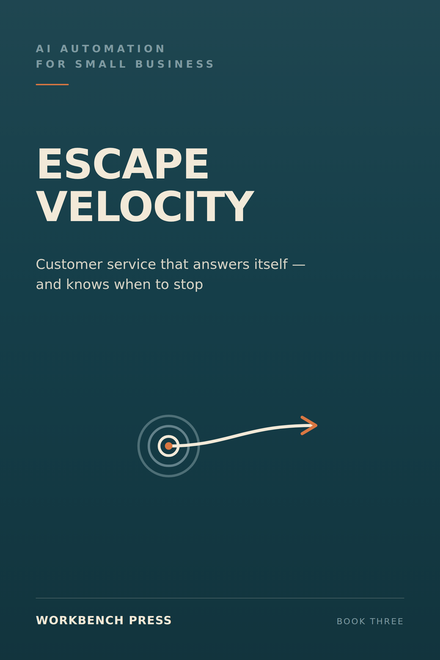 Book Three
Escape Velocity
Customer service that answers itself, and knows when to stop.
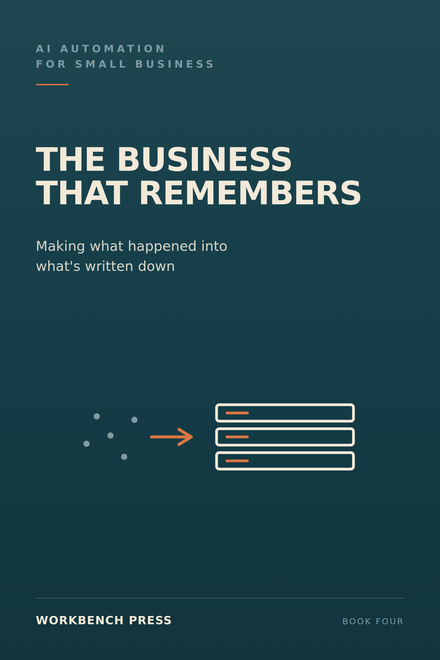 Book Four
The Business That Remembers
Making what happened into what is written down.
 Book Five
The Machine Room
Wiring the four workflows into one system you can maintain.
What you will have built by the end
- A ranked, costed list of every hour your business eats — and a written estimate for the worst one.
- A six-sheet price book with a live quote builder, so quoting becomes lookup instead of judgement and somebody else can do it.
- An intake and follow-up system where every inquiry has an owner, a next date, and a rule for when to stop.
- A grounded support workflow that answers from approved material, cites its source, and routes anything unclear or unsafe to a person.
- A decision log that survives whoever wrote it, with duplicates prevented on the way in rather than cleaned up afterwards.
- A cost model that separates saved hours from saved money, and a failure runbook for when something breaks at 2am.
Pages from inside the books
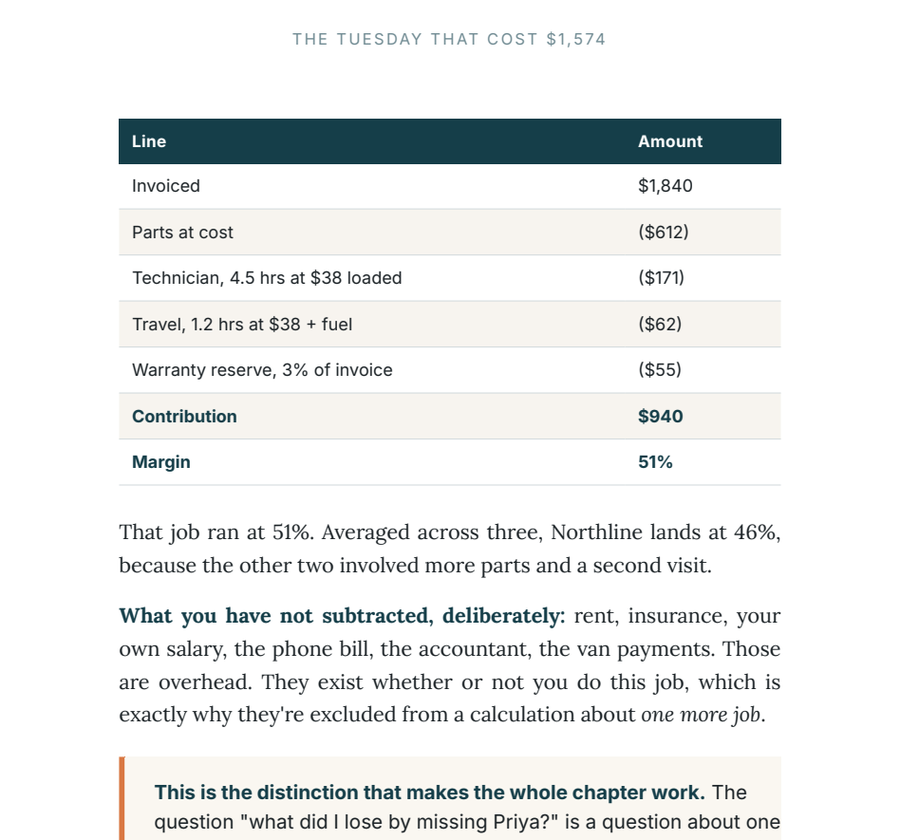
Book One. What one missed job actually cost — line by line, with the reason overhead is deliberately excluded.
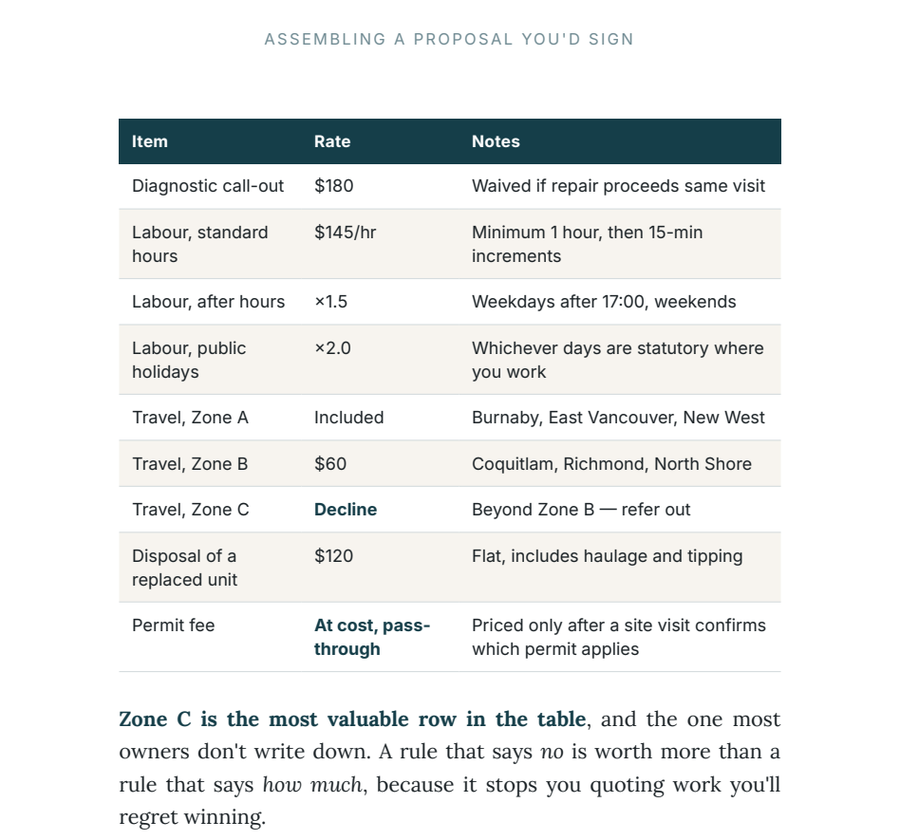
Book Two. The price book that turns quoting into lookup, including the row that tells you which work to refuse.
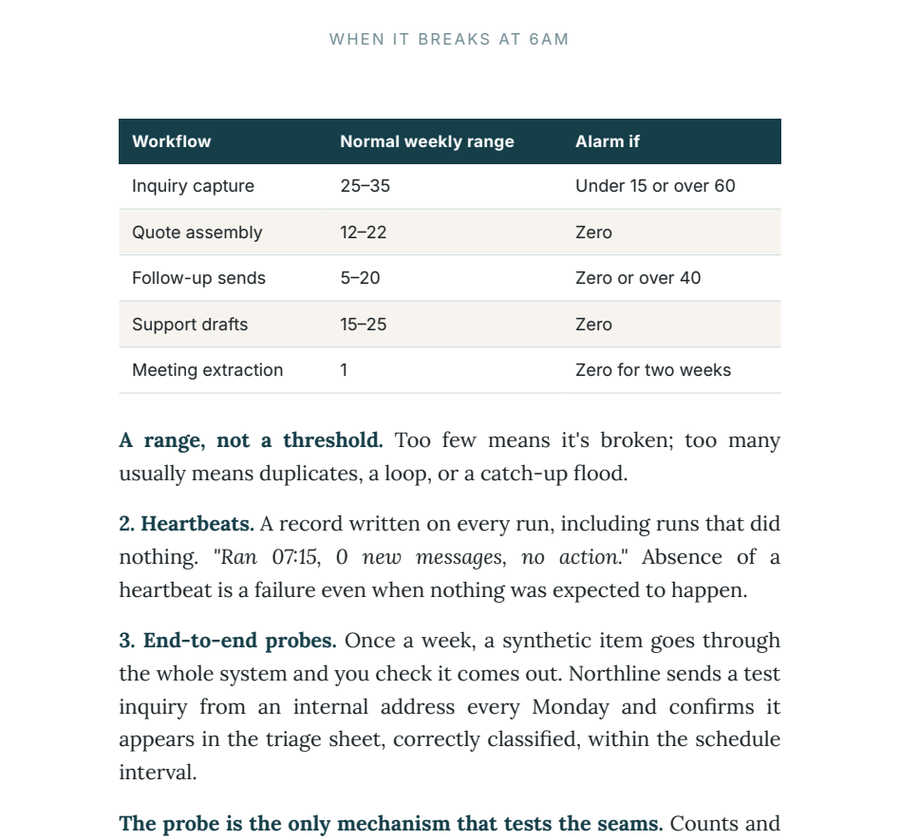
Book Five. How you know the system is still working — normal ranges, heartbeats, and the weekly probe.
Why these work when other books don’t
You build something in every chapter. Each one starts with a specific business problem and ends with a finished piece of work — a scored audit, a price book, a triage spec, a decision log. Nothing is left as an exercise for the reader.
The arithmetic is shown, and it holds. Every financial figure was recalculated independently before publication. You can follow the money from the first number to the last and check it yourself, which means you can defend it to a partner, an accountant, or your own doubts at 11pm.
They tell you where AI is the wrong tool. Money, dates, duplicate checks and permissions are formulas, not model work. Knowing which is which is the difference between a system you trust and one you babysit.
Everything stops. Every workflow specifies what halts it, who can turn it off, from where, and how fast. There is a one-page stop list you fill in and put on a wall — so you can hand the system to someone else without lying awake about it.
One running example throughout. A five-van mechanical contractor, followed across all five books, with real numbers that move as the system gets built. You see the whole thing assembled, not five disconnected tutorials.
No screenshots to go stale. Menus move. The books design; the dated supplement wires, and gets reissued free when platforms change. Your copy doesn’t rot.
Build Notes
Build Notes — Edition 1.0
31 pages. Included at no cost with the bundle. It builds every workflow in the five books on tools that are free with an ordinary personal account, then specifies what changes when you connect them. Every external claim carries its source and the year it was read. It is reissued when platform detail changes, and you receive new editions free for the life of Edition 1.
Get the bundle
On your statement the charge appears as
LINK.COM* WORKBENCHPRE — Stripe handles payment and tax as
merchant of record, so their name leads.
Licence: one reader, one business. Print it, adapt the templates, use what you build commercially. No resale or redistribution. Full terms and privacy policy.
Questions before buying: hello@workbenchpress.com, typical reply within two business days.
You get everything the moment you pay, so sales are final. That is why a full chapter is free to read first.
Asked and answered
How long before I have something working?
The Friday Audit takes five minutes a day for a week and gives you a costed list of what your business actually eats. Your first working automation lands in Book One. The full system across all five books is a project measured in weeks, deliberately — the review steps are where you find out what your form asks wrong.
Do I need to pay for AI tools on top?
No. The main path in Build Notes uses a form, a spreadsheet and a chat assistant on its free tier. Where a step could cost money, the supplement says so before you get there and gives the free route first.
Do I need to be technical?
No coding anywhere. If you can write a spreadsheet formula, you can build everything in these books. Every prompt is copyable, every field mapping is written out, and every step has an expected output so you know whether it worked.
I’m a one-person business. Is this overkill?
Books One and Two are written with a one-person business in mind — the price book and the follow-up system pay off immediately at any size. Book Five is honest about the point where automation costs a one-van operation more than it saves, so you don’t build something you’ll resent.
Will this work outside Canada?
Yes. No country-specific figures, tax rules or vendors. Where local law matters — consent, record-keeping — the books tell you which question to ask locally rather than answering it for you.
What if the software changes?
Build Notes is reissued when platform detail changes, and you get every new edition free for the life of Edition 1. The books themselves are written to outlast interface redesigns, which is why there are no screenshots in them.
Can I use what I build commercially?
Yes. Adapt the spreadsheets and templates however you like, run them in your own business, keep whatever they earn. No royalty, no attribution.
Can I buy one book instead of the bundle?
Not at the moment. The five share one running example and build in sequence — a single book out of order would be a worse product than the set.
Contact
Questions about a book, a correction, or a file that didn't arrive:
Corrections are welcome and are published with the next edition of the affected book.